
Poly — A Death Investigation Report
Part of 36 Kilometres: From Home to Work
In March 2018, a worker surnamed Pang fell to his death from the building where I lived. Two years later, I moved into that building. The place from which he fell is exactly what I see when I look out from my balcony.
- Year
- 2026
- Location
- Suburbs
- Medium
- Text
Translator’s note. What follows is a complete English translation of a Chinese administrative report: the full text of the investigation report. Names of people and places, organisation names, document numbers and precise dates have been withheld; the rest is unaltered. It keeps the original’s paragraphs, numbering and headings. Selected terms are followed by the Chinese original in small type〔like this〕.
Black bars: names of people and places, organisation names, document numbers and precise dates, withheld by this page. The asterisks in the ID number are in the original.
Notes A–J in the margin are the author’s. Notes marked † are translator’s glosses on Chinese terms; they are not part of the report.
Thin lines in the margin connect passages that lie far apart in the report. Hover over a note, or focus it with the Tab key, to see the passages it refers to.
Accident Investigation Report
At about 05:00 on (withheld) March 2018, a fall-from-height accident occurred above the basement roof slab of (withheld)F of the (withheld) in (withheld) Town, (withheld) District, (withheld), causing one death.
After the accident, persons at the scene immediately called the 110 police line and the 120 emergency medical dispatch centre. At about 06:00, officers from (withheld) Police Station and 120 ambulance personnel arrived at the scene at the same time; after an on-site examination by the medical personnel, the injured person (Pang (name withheld), from (withheld), Guangdong) was confirmed dead.
Subsequently, a member of the public reported to the Ministry of Emergency Management that the accident unit, the (withheld), had concealed the accident瞒报事故A. Accordingly, on (withheld) AugustA, the Office of the (withheld) Work Safety Committee sent the Office of the (withheld) District Work Safety Committee a “Letter Forwarding a Request to Verify and Investigate a Suspected Concealment of a Work Safety Accident” ((withheld)), requiring that relevant personnel be organised to verify the matter conscientiously and deal with it strictly.
AAfter the tip-off
The investigation began with “a member of the public reported to the Ministry of Emergency Management that the accident unit, the (withheld), had concealed the accident” 瞒报, and with a letter from the municipal Work Safety Committee Office nearly five months after the incident.
The Investigation Team was formed about two weeks after that letter, nearly five months after the incident.
Until then, the General Contractor’s Project Department and its superior units “did not report the accident to the government’s work safety authorities”.
Refers to “a member of the public reported to the Ministry of Emergency Management that the accident unit, the (withheld), had concealed the accident” “on (withheld) August” “On (withheld) August” “did not report the accident to the government’s work safety authorities”
On (withheld) AugustDA, as authorised by the (withheld) District Government, the District Work Safety Supervision Bureau took the lead in organising the District Public Security Sub-bureau, the District Federation of Trade Unions, the District Human Resources and Social Security Bureau, the District Housing and Construction Bureau, the District Market and Quality Supervision Bureau, the (withheld) Town Government and other relevant units, and invited the District People’s Procuratorate to send personnelJ, to form the Investigation Team for the (withheld) Fall-from-Height Accident at Phase I of the (withheld), (withheld) Town, (withheld) District, (withheld), and to carry out the investigation and handling of the accident. Adhering to the “four no-lets-go”四不放过†1 principle of accident investigation and handling and to the basic principles of respecting science and seeking truth from facts, the Investigation Team, through site examination and the collection of evidence, and on the basis of a comprehensive analysis of evidence including statements by the parties concerned, site examination records, witness testimony and expert opinions, has established the course of the accident and the emergency response, analysed the causes of the accident, determined its nature, and produced this investigation report.
†1“Four no-lets-go” 四不放过Translator’s gloss
A standard principle of Chinese accident investigation: the matter is not let go until the cause has been identified, those responsible have been dealt with, corrective measures have been implemented, and the people concerned have been educated.
I. Basic Information
(I) Project Overview
The (withheld) construction project in (withheld) Town, (withheld) District, (withheld) is located on the south side of (withheld) and on the east bank of the (withheld) in (withheld) Town, (withheld) District, (withheld). It has a floor area of approximately 330,000 square metres and comprises 16 buildings of 26 storeys (some with a 1F podium), one 3-storey building and a 20,000-square-metre show area. On (withheld) July 2016, the project obtained Construction Works Construction Permit No. (withheld) issued by the (withheld) District Housing and Construction Bureau (hereinafter “(withheld) Housing and Construction Bureau”).
(II) Participating Units and Organisation and Implementation of the Works
1. Developer
(withheld) (hereinafter “(withheld)”), domicile: (withheld), (withheld) Town, (withheld) District, (withheld); legal representative: (withheld); date of establishment: (withheld) October 2015; business scope: real estate.
2. Construction Supervisor
(withheld) (hereinafter “(withheld)”), domicile: Room 411A, No. 11 (withheld), (withheld); legal representative: (withheld). It holds a comprehensive qualification for construction supervision.
On (withheld) May 2016, (withheld) and (withheld) signed the “Entrusted Supervision Contract for Section 1 of the (withheld)”, and a project supervision team was established immediately thereafter. The chief supervisor’s representative was (withheld); at the time of the accident, the on-site supervisor for (withheld) of the project was (withheld).
3. General Contractor
(withheld) (hereinafter “(withheld)”), domicile: 5/F, Block B, (withheld), No. 16 (withheld), (withheld), (withheld); legal representative: (withheld). It holds a Special Grade qualification for general contracting of building construction. In May 2016, (withheld) and (withheld) signed the “General Contract for the Survey, Design and Construction of (withheld)”, with a contract period from (withheld) May 2016 to (withheld) May 2022. The contracted scope comprised all engineering surveys, engineering scheme design, construction drawing design and general construction contracting. On (withheld) June 2016, (withheld) established the (withheld) of (withheld) (hereinafter “the General Contractor’s Project Department”), which carries out the specific organisation, implementation and control of the project and bears overall responsibility for its quality, safety, cost and schedule targets. The General Contractor’s Project Department operates an executive manager responsibility system; at the time of the accident, the executive manager was (withheld).
(withheld) placed the project department under the management of the (withheld) (hereinafter “(withheld)”). (withheld), Deputy General Manager of (withheld) responsible for business in the (withheld), was the official in charge of this project department.
Upon investigation, the general contractor and the subcontractor had established and implemented a hierarchical safety responsibility system as required, formulated construction safety rules and operating procedures of all kinds, set up safety management bodies and staffed them with full-time safety managers; the project manager and other safety management personnel had obtained safety assessment certificates as required and worked with valid certificates; regular safety inspections and special inspections had been instituted and carried out, and hidden hazards found during inspections had basically been rectified as required; and an accident emergency plan had been drawn up. All of the subcontractor’s workers entering the site had received safety education and passed assessment before taking up their postsG, and all special-operations personnel held certificates; the subcontractor kept a register of its construction personnel, who received the general contractor’s three-level safety education三级安全教育†3 and routine safety education, training and technical briefings as required.
4. Labour Subcontracting
(1) Subcontractor
(withheld) (hereinafter “(withheld)”), domicile: Room 201, No. 61 (withheld), (withheld), (withheld); legal representative: (withheld). It holds a Grade II qualification for masonry labour subcontracting and a qualification for plastering labour subcontracting, and holds a construction work safety production licence.
On (withheld) June 2017, (withheld) and (withheld) signed a construction labour subcontract covering the masonry and plastering works for (withheld) of (withheld) and the corresponding commercial podiums and basements. The company subsequently appointed (withheld) as its on-site representative to organise and manage the work.
(2) Plastering Posts
Plastering work consists of three processes, mixing mortar, transporting mortar and plastering (skimming), and is managed by the masonry and plastering team, whose team leader was Chen (name withheld). At the time of the accident, the worker responsible for mixing mortar at (withheld) was Yuan (name withheld), the worker transporting mortar was Pang (name withheld), and more than ten workers including Zhan (name withheld) were responsible for plastering (skimming). Division of labour among the plastering posts: the mortar-mixing worker loads the mixed mortar into carts and takes it to the entrance of the construction hoist; the mortar-transporting worker uses the construction hoist to carry the mortar to each plastering (skimming) work point and hands it over to the workers for application. Mortar-mixing and mortar-transporting workers usually start work about half an hour earlyI, in order to prepare materials for the plastering (skimming) workers.
(3) Pang (name withheld)’s Three-Level Safety Education†3
On (withheld) March 2018G, (withheld), Safety Director of (withheld), gave Pang (name withheld) safety education covering basic safety knowledge, laws and regulations; on (withheld) March, (withheld), head of the Safety Department of the General Contractor’s Project Department, gave Pang (name withheld) safety education covering site rules and regulations and compliance with discipline; on (withheld) March, Chen (name withheld), leader of the masonry and plastering team of the General Contractor’s Project Department, gave Pang (name withheld) safety education covering safe operation for this trade and team safety rules and discipline.
†3Three-level safety education 三级安全教育Translator’s gloss
Induction safety training required for construction workers, given at three levels: company, project department and work team. “On (withheld) March 2018” records one session at each level, a week before the incident.
5. Operators of the Construction Hoist at (withheld)
Under the “Construction Hoist Lease Contract” signed between (withheld) and (withheld), the lessor assigned Li (name withheld) and Chen (name withheld) to operate the construction hoist at (withheld).
Upon investigation, the operator on the early shift at the time of the accident was Li (name withheld).
(III) Relevant Machinery, Equipment and Safety Facilities
1. Construction Hoist
(1) Owner
(withheld) (hereinafter “(withheld)”), domicile: Room 1229, (withheld), No. 17 (withheld), (withheld), (withheld); legal representative: (withheld); business scope: leasing.
(2) Manufacture
Manufacturer: (withheld);
Model: SC200/200TD (double cage);
Date of manufacture: (withheld) July 2015;
Property registration number: Yue AE-S02768;
Factory serial number (withheld);
Upon investigation, the construction party installed this hoist at the intersection of axis (withheld) and axes 11–12 of (withheld) and numbered it “(withheld)”.
(3) Installation and Maintenance Unit
(withheld) (hereinafter “(withheld)”), domicile: 232, Unit 2, 2/F, No. 3, (withheld), (withheld), (withheld), (withheld); legal representative: (withheld). It holds a Grade III specialised contracting qualification for lifting equipment installation works and a construction-sector safety production licence. On (withheld) October 2016, (withheld) and (withheld) signed a “Construction Hoist Installation Contract” and a “Safety Management Agreement for Installation of the (withheld) Construction Hoist”.
On (withheld) April 2017, the construction party filed an installation notification with the (withheld) District Construction Works Quality and Safety Supervision Station (hereinafter “(withheld) Quality Supervision Station”). On (withheld) May 2017, the construction hoist was tested and rated as qualified by (withheld); on (withheld) June 2017, (withheld) Quality Supervision Station issued a construction lifting machinery use registration plate for the hoist.
On (withheld) May 2017, (withheld) and (withheld) signed a maintenance contract for the construction hoist at (withheld), stipulating that (withheld) would be responsible for the repair and maintenance of the construction hoist at (withheld).
2. External Scaffolding
On (withheld) October 2016, (withheld) organised the preparation of the “Special Construction Scheme for Scaffolding of (withheld), (withheld)”. On (withheld) October 2016, at a scheme review meeting organised by the (withheld) District Construction Industry Association, experts approved the scheme. After erecting the external scaffolding, the General Contractor’s Project Department organised acceptance as required.
3. Safety Nets
Manufacturer: (withheld), (withheld), (withheld) (hereinafter “(withheld)”).
On (withheld) October 2016, (withheld) and (withheld) signed a “Framework Agreement for the Procurement of Safety Nets in the Guangdong Region”, under which the two parties agreed on the purchase and sale of safety nets and horizontal safety nets.
(IV) Construction Progress and Work Assignments
Upon investigation, before the accident the main structure of (withheld) had been completed, and the construction party was organising workers to carry out interior wall plastering on the 14th to 16th floors of (withheld)F. All construction workers were dispatched by (withheld).
II. Course of the Accident and Emergency Response
(I) Course of the Accident
At about 05:00 on (withheld) March 2018, Zhan (name withheld) and his wife Rao (name withheld), workers responsible for plastering the interior walls of the stairwell on floors 15–16 of (withheld) of the (withheld), arrived at the ground floor of (withheld). At the entrance of the construction hoist they saw Pang (name withheld), the worker in the same building responsible for transporting mortar, who was then preparing to operate the construction hoist to carry mortar upstairs, and so they rode up in the construction hoist together; the couple then began work. At about 05:20, Yuan (name withheld), the worker responsible for mixing mortar on the ground floor, ran upstairs and told Zhan (name withheld) that he had heard someone cry out “Ah!”, felt that something was wrong, and asked Zhan (name withheld) to go with him to look for Pang (name withheld). The two went up several floors by the stairs but did not find him, so they turned back to search downstairs. At about the 10th floor, Yuan (name withheld) told Zhan (name withheld) that he could see what seemed to be a person lying on the ground at ground level, so the two ran all the way down the stairs to the ground floor.
After running down to the ground floor, Zhan (name withheld) and Yuan (name withheld) found a person lying on the basement roof slab of (withheld), about 6 metres east of the construction hoist. On identification, the person was Pang (name withheld). He was lying face down, with blood and brain matter flowing from his head. They did not touch his body, and immediately called Pang (name withheld)’s name, but he did not respond. By then several workers had arrived one after another and were looking on; onlookers called the 110 police line and the 120 emergency medical dispatch centre. At about 06:00, police and 120 ambulance personnel arrived at the scene at the same time; after an on-site examination, the 120 medical personnel confirmed that Pang (name withheld) was dead.
(II) Emergency Response at the Scene
After the accident, persons at the scene immediately called the 110 police line and the 120 emergency medical dispatch centre. At 05:40, (withheld), safety supervisor of the project department, and (withheld), production manager, immediately dispersed the onlooking workers and then notified the construction team leaders to have the workers stop work.
Shortly after 08:00, some of the deceased’s family members arrived at the scene; several of them were emotionally out of control. At about 09:00, (withheld), the (withheld) official in charge of the project, arrived at the scene and immediately organised efforts to console and calm the deceased’s family. At about 14:00, more than 30 of the deceased’s principal family members arrived at the General Contractor’s Project Department one after another in more than ten vehicles, surrounded the project department and the developer’s (owner’s) sales office, and stated that they would go to the (withheld) District Government and relevant departments to petition上访†2. Because this was the special period of the national “Two Sessions”两会B†2, in order to reduce the pressure on the government, to demonstrate the social responsibility of a central state-owned enterprise体现央企的社会职责担当†2 and to maintain social stability保持社会稳定, and in consideration of the family’s financial hardship and the fact that the deceased left behind orphaned children and a widow孤儿寡母†2, while the public security authorities’ criminal investigation had not reached a conclusion在公安部门刑事调查未有结论的情况下C, (withheld), after collective discussion and agreement by all of its leaders responsible for the (withheld), granted the family humanitarian assistance人道主义补助 of 2.48 million yuanB, and on the morning of (withheld) March paid the full amount of the assistance to the deceased’s family于3月(已隐去)日上午将该补助款全部支付给死者家属C. The family then left in stages, and the pressure of stability maintenance was relieved维稳压力得到缓解B†2.
†2Terms in “humanitarian assistance”Translator’s gloss
petition 上访: to take a complaint in person to a higher level of government through the petitioning (xinfang) system.
“Two Sessions” 两会: the annual plenary sessions of the National People’s Congress and the Chinese People’s Political Consultative Conference, held in Beijing in March.
central state-owned enterprise 央企: an enterprise owned and supervised by the central government.
stability maintenance 维稳: official shorthand for “maintaining social stability”, i.e. preventing and defusing protests, petitions and other collective incidents.
orphaned children and a widow 孤儿寡母: a set phrase, literally “orphans and widowed mother”.
(III) Casualties and Economic Losses Caused by the Accident
The accident caused one death in total. Details: Pang (name withheld), male, aged 36, ID card number: (withheld). Address on ID card: (address withheld), (withheld), (withheld), Guangdong Province.
Direct economic loss直接经济损失: 2.48 million yuan.B
B“Two Sessions” / 2.48 million yuan
The reasons given for the payment, in order: the special period of the “Two Sessions” 两会; “to reduce the pressure on the government”; “to demonstrate the social responsibility of a central state-owned enterprise” 体现央企的社会职责担当; “to maintain social stability”; the family’s “financial hardship”; and “orphaned children and a widow” 孤儿寡母. The payment is called “humanitarian assistance of 2.48 million yuan” 人道主义补助; the outcome: “the pressure of stability maintenance was relieved” 维稳压力得到缓解.
The same amount is recorded as “Direct economic loss: 2.48 million yuan.” 直接经济损失.
The same money has two names: “humanitarian assistance of 2.48 million yuan”, and “Direct economic loss”.
Refers to “Because this was the special period of the national “Two Sessions”” “humanitarian assistance of 2.48 million yuan” “the pressure of stability maintenance was relieved” “Direct economic loss: 2.48 million yuan.”
(IV) Receipt of Information and Assessment of the Initial Emergency Response
Based on a preliminary understanding of the circumstances at the scene, the leaders of (withheld) considered that the accident did not fit the characteristics of a construction safety accident, and suspected that the place of the accident was not the primary scene and that it might involve a criminal case, among other things. On this basis, at about 15:00 on (withheld) March, (withheld), executive manager of the project, went to the public security authorities again to request an in-depth investigation, whereupon the criminal investigation brigade of the District Public Security Sub-bureau intervened immediately and examined the construction hoist of (withheld), a building near the scene, as well as each floor and other locations; the examination ended at about 02:00 the following morning.
Throughout the handling of the incident, and especially after the project department reported the matter to the criminal police for investigation, the deceased’s family, worried that they would not receive compensation if it were confirmed as a criminal case, were emotionally out of control, and more than 30 family members surrounded the General Contractor’s Project Department until late at night. At the same time, because of repeated obstruction by the deceased’s family, the public security authorities were not able to examine the body until the sixth day after the incident.
Upon investigation, as of the time this report was produced, the public security authorities’ criminal investigation had still not reached a clear conclusion刑事调查仍未得出明确结论C and the accident was still at the stage of an uncompleted criminal investigation; therefore, the General Contractor’s Project Department and its superior units did not report the accident to the government’s work safety authorities未向政府安全生产有关部门报告该事故A.
CPaid first, classified later
The assistance was paid in full on the morning after the incident, “while the public security authorities’ criminal investigation had not reached a conclusion” 在公安部门刑事调查未有结论的情况下.
When the report was produced, the “criminal investigation had still not reached a clear conclusion”; “therefore” the General Contractor’s Project Department and its superior units did not report the accident to the work safety authorities.
“the accident unit did not conceal the accident” 事故单位不存在瞒报行为.
Classified as “a non-production-safety liability accident” 非生产安全责任事故.
The conclusion of the criminal investigation does not appear in the report.
Refers to “while the public security authorities’ criminal investigation had not reached a conclusion” “on the morning of (withheld) March paid the full amount of the assistance to the deceased’s family” “criminal investigation had still not reached a clear conclusion” “the accident unit did not conceal the accident” “was a non-production-safety liability accident”
The Investigation Team considers that, after the accident, the accident unit was able to activate its emergency plan promptly, reported to the public security and health authorities in a timely manner, and handled the entire process quickly and properly during the stage of the uncompleted criminal investigation; the receipt of information and the initial emergency response basically met the procedural requirements for on-site rescue and accident emergency response, and the accident unit did not conceal the accident事故单位不存在瞒报行为C.
III. Site Examination and Technical Examination and Analysis
(I) Examination and Inspection by the Public Security Authorities
1. Site Examination
Injuries of varying degrees were found on the head, hands, legs and other parts of the body, with large amounts of blood on the head and legs.
On the north side of (withheld) at the scene there are two construction hoists, the east construction hoist and the west construction hoist. The east construction hoist has one door each on its south and north sides: the north door is an upward-lifting door and the south door is an up-and-down closing door, with a latch on the closing door; a control panel is located on the east side of the middle of the hoist. The west construction hoist has one door each on its south and north sides: the north door is an upward-lifting door and the south door is an up-and-down closing door, with a latch on the closing door; a control panel is located on the west side of the middle of the hoist.
At the scene, a handcart was found in front of the construction door on the west side of the 14th floor of (withheld), and scrape marks were found on the ground in front of the construction door on the east side of the 14th floor of (withheld).
At the scene, the bolt of the construction door on the east side of the 27th floor of (withheld) was found to be damaged.
2. Autopsy: On (withheld) March 2018, the Forensic Identification Centre of the (withheld) District Public Security Bureau, (withheld), Guangdong issued an Expert Opinion ((withheld)), with the opinion that the death of the deceased Pang (name withheld) was consistent with severe craniocerebral injury caused by a fall from height.
(II) Site Examination by the Investigation Team
The Investigation Team examined the scene three times, on the morning of (withheld) AugustD, the afternoon of (withheld) August and the evening of (withheld) September. The findings are as follows:
D(withheld) August / (withheld) August
“On (withheld) August”: the Investigation Team was formed.
“on the morning of (withheld) August” 8月(withheld)日上午: the team examined the scene three times; this was the first.
The first site examination took place three days before the team was formed.
Refers to “On (withheld) August” “on the morning of (withheld) August”
1. Location of the Body After the Fall and Its Surroundings
On the basis of photographs of the scene and the identification and statements of persons present, the Investigation Team has basically established the location where Pang (name withheld) landed and its surroundings.
After the fall, the body lay in a north–south orientation (head to the north). To the east is a planned road of the residential compound; to the south, the external scaffolding is 5.2 metres away; to the west, the mast of the construction hoist is 6.2 metres away; to the north is the open space between it and (withheld).
The horizontal straight-line distance from the entrance of the construction hoist to the body is 9.4 metres.
2. Construction Hoist
(1) Model: SC200/200TD;
(2) Cage type: double cage;
(3) Cage dimensions (interior): length 3.2 metres, width 1.5 metres, height 2.5
(4) State of the hoist at the time of the accident:
According to statements by persons present at the scene, at the time of the incident the east cage was stopped at the 27th floor, with its north cage door closed and its south cage door and landing door open; the west cage was stopped at the 14th floor, with its north cage door closed and its south cage door and landing door open.
After the incident, the operators lowered the two construction hoists to the ground floor for inspection and found signs of deliberate damage to the north cage door locks and the control panel power switches of both the east and the west cages.
3. External Scaffolding
(1) Spacing of standards: longitudinal, inner and outer: 1.5 metres; transverse: 0.8 metres;
(2) Distance from the inner row of standards to the wall: 0.2 metres;
(3) Vertical spacing of longitudinal horizontal tubes: 1.8 metres;
(4) Length of transverse horizontal tubes projecting towards the wall: 0.15 metres.
(5) The vertical heights of the external scaffolding at the 14th and 27th floors are 40 metres and 78 metres respectively.
4. Night-time Lighting of Construction Floor Passages and Construction Hoist Entrances
(1) The construction party installed one 500-watt LED lamp on each tower crane; the brightness of the ground between buildings is sufficient for pedestrians to walk;
(2) At the construction hoist entrances on all floors, the construction party installed an LED light strip 3 metres long with a power of 8 watts; there is sufficient light for entering and leaving the construction hoist.
5. Safety Nets
Because safety nets are consumable items易损耗品, the Investigation Team did not examine the safety nets hung on the external scaffolding at the sceneE, and conducted only an analysis of witness testimony and documentation:
ESafety net
The point of fall determined is “the hole in the safety net on the external scaffolding at the 27th floor of (withheld)”.
“Because safety nets are consumable items, the Investigation Team did not examine the safety nets hung on the external scaffolding at the scene” 易损耗品.
The descriptions of the hole — “an opening large enough for a person to pass through”, “the hole was suspected to have been caused by deliberate damage” — come from witness accounts and from a floor-by-floor inspection by four persons arranged by the developer on the day of the incident.
The report states that the safety nets were “installed the external scaffolding and safety nets of (withheld) as required”.
Refers to “Because safety nets are consumable items, the Investigation Team did not examine the safety nets hung on the external scaffolding at the scene” “an opening large enough for a person to pass through” “the hole was suspected to have been caused by deliberate damage” “the hole in the safety net on the external scaffolding at the 27th floor of (withheld)” “installed the external scaffolding and safety nets of (withheld) as required”
(1) The manufacturer of the safety nets holds a National Industrial Product Production Licence, and this model of safety net passed inspection by the National Work Safety Beijing Labour Protection Products Testing and Inspection Centre and is a qualified product.
(2) The safety nets used in the works were sampled in the presence of personnel from the supervision unit, and passed inspection by the Guangdong Building Materials Product Quality Inspection Centre on (withheld) August 2016.
(3) According to the accounts of (withheld), (withheld), (withheld) and (withheld), relevant managers of the developer, and construction workers Zhu (name withheld), Yang (name withheld) and others, at the time of the accident the entire façade of (withheld) facing the place where the deceased landed was intact without obvious damage, except for an opening large enough for a person to pass through有一个可容人穿越的洞口E on the 27th floor (top floor) directly above the landing point.
6. Condition of Floors at Open Edges
The Investigation Team inspected each floor of (withheld) of the project, where interior wall plastering was under way正在进行内墙抹灰工作的(已隐去)楼F, and found no obvious slipperiness on the floors at open edges such as construction hoist entrances.
F(withheld) / (withheld)
The accident occurred “above the basement roof slab of (withheld)”.
Before the accident there was “interior wall plastering on the 14th to 16th floors of (withheld)”.
The check for slippery floors was made where they “inspected each floor of (withheld) of the project, where interior wall plastering was under way” 正在进行内墙抹灰工作的(withheld)楼.
The report does not say why (withheld) was inspected.
Refers to “above the basement roof slab of (withheld)” “interior wall plastering on the 14th to 16th floors of (withheld)” “inspected each floor of (withheld) of the project, where interior wall plastering was under way”
(III) Inspection by the Accident Unit
In order to establish where Pang (name withheld)’s fatal fall took place, at about 09:00 on (withheld) March, the developer arranged for four persons, chief supervisor’s representative (withheld), on-site supervisor (withheld), production manager (withheld) and safety supervisor (withheld), to inspect floor by floor the safety nets on the side of (withheld) facing the place where the deceased landed. They found a hole in the safety net on the 27th floor (top floor) directly above the landing point; the hole was suspected to have been caused by deliberate damage该破洞疑似人为破坏所至E and was not natural wear; the safety nets elsewhere were well closed, and no obvious damage was found.
IV. Circumstances Relating to the Accident: Personal Circumstances of the Deceased
Pang (name withheld) was a worker in the masonry and plastering team of the labour subcontractor (withheld); he began working on the (withheld) in November 2017其在2017年11月开始在(已隐去)项目工作G. After the accident, the Investigation Team interviewed 12 workers, including Zhan (name withheld), who also worked on (withheld), and learned the following about Pang (name withheld)’s personal circumstances:
GBefore taking up posts / Nov 2017 / (withheld) Mar 2018
All of the subcontractor’s workers entering the site “had received safety education and passed assessment before taking up their posts” 上岗前都经安全教育并考核合格.
“he began working on the (withheld) in November 2017”.
His three-level safety education is recorded “On (withheld) March 2018”, and on the following day, a week before the incident.
Three-level safety education was “implemented” 落实.
The report records no safety education between November 2017, when he started on site, and the week before the incident.
Refers to “All of the subcontractor’s workers entering the site had received safety education and passed assessment before taking up their posts” “On (withheld) March 2018” “he began working on the (withheld) in November 2017” “implemented three-level safety education for …”
(I) Personality: usually melancholy and taciturn; rather withdrawn before the incident;
(II) Mental state: before the incident his spirits were poor; he did not respond when workmates from his home area greeted him, and he had heavy dark circles under his eyes.
(III) Hobbies: liked drinking, and often read books about Mark Six lottery gambling.
(IV) Physical condition: in somewhat poor health, often sat resting on the site, and was often seen taking medication for mental illness such as “clozapine tablets”.
(V) Financial situation: after the Spring Festival, he borrowed 6,000 yuan from a dormitory roommate and did not repay it; in early March, he asked another workmate for a loan of 10,000 yuan; on (withheld) March, he asked the team leader for an advance of 50,000 yuan for urgent use, which was not granted; on (withheld) March, he drew his wages from the team leader.
V. Analysis of the Causes of the Accident
(I) Analysis of the Deceased’s Point of Fall
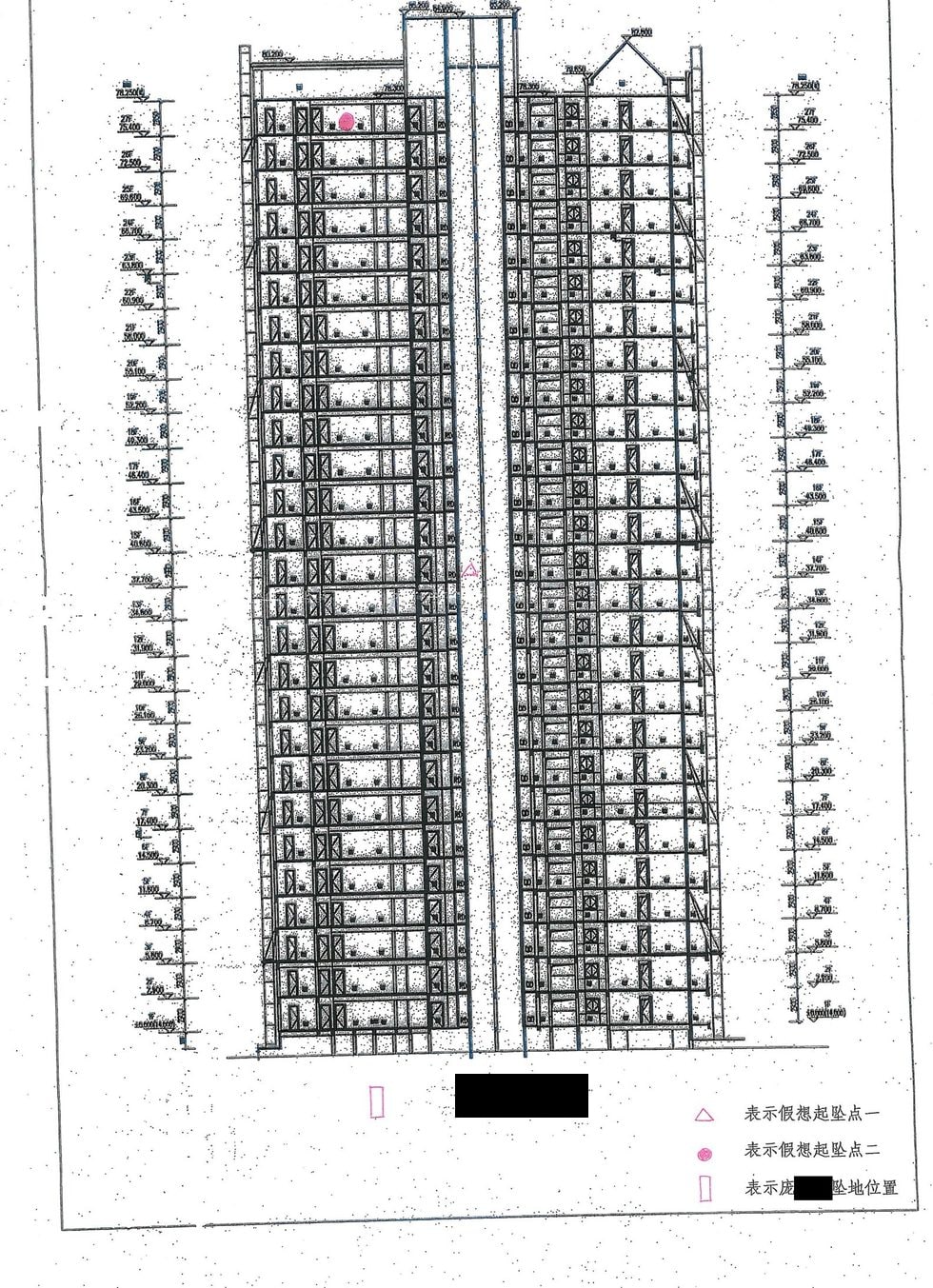
Section of (withheld). Cropped from Attachment 3(1).(withheld)楼剖面图。据附件3(1)裁切。
△ hypothetical point of fall 1假想起坠点一 ● hypothetical point of fall 2假想起坠点二 □ landing position坠地位置
On the basis of the accounts of the accident unit and of persons present, and after pooling all opinions, the Investigation Team identified two hypothetical points of fall for Pang (name withheld)’s fall from height, analysed as follows:
1. Hypothetical point of fall 1: the landing door of the construction hoist at the 14th floor of (withheld)
(1) Analysis of an accidental fall
According to the principles of mechanics, in an accidental fall from the landing door of the construction hoist at the 14th floor, the body should land directly below the landing door, and not at the location where Pang (name withheld) landed.
(2) Analysis of a fall caused by jumping out
By calculation, the horizontal distance from the landing door of the construction hoist at the 14th floor of (withheld) to the location where Pang (name withheld) landed is 9.4 metres. According to the principle of uniformly accelerated rectilinear motion, a person jumping out at a speed of 11.66 kilometres per hourH could reach the location where Pang (name withheld) landed.
However, generally speaking, the orientation of a body after landing should be consistent with the direction of the line of horizontal distance between the take-off point and the landing point, which is not the orientation of Pang (name withheld)’s body after landing.
2. Hypothetical point of fall 2: the hole in the safety net on the external scaffolding at the 27th floor of (withheld)
According to the principles of mechanics, whether by an accidental fall or by jumping outH, a person could reach the location where Pang (name withheld) landed, and the orientation of the body after landing would be consistent with that of Pang (name withheld)’s body after landing.
Accordingly, the Investigation Team considers that the point of fall of Pang (name withheld)’s fall from height was the hole in the safety net on the external scaffolding at the 27th floor of (withheld)(已隐去)楼27层外脚手架安全网的破洞口位置E.

Redrawn from Attachment 2.据附件2重绘。
一、位移距离的计算: c = √(6² + 7.3²) = 9.4m
二、落地时间的计算: t = √(2 × 40 / 9.8) = 2.9s
起跳水平速度的计算: v = 9.4 / 2.9 = 3.24m/s = 11.66km/h
1. “A” is hypothetical point of fall 1, at the construction-hoist landing door on the 14th floor, 40 m from the ground, horizontal distance to the fallen person 9.4 metres.“A"为模拟起坠点一,在14楼施工人货梯层门位置,距地面40m,与坠地者水平距离9.4米。
2. “B” is hypothetical point of fall 2, on the external scaffolding at the 27th floor, 78 metres from the ground, horizontal distance to the fallen person 6 m.“B”为模拟起坠点二,在27层外脚手架上,距地面78米,与坠地者水平距离6m。
HFigures for point 1, none for point 2
Attachment 2’s calculation applies only to hypothetical point of fall 1 (14th floor, 40 m from the ground). Hypothetical point 2 appears only in Attachment 2’s remarks: “B” is hypothetical point of fall 2, on the external scaffolding at the 27th floor, 78 metres from the ground, horizontal distance to the fallen person 6 m. “B”为模拟起坠点二,在27层外脚手架上,距地面78米,与坠地者水平距离6m。
“whether by an accidental fall or by jumping out”: no figures are given for point 2.
See the figure (redrawn from Attachment 2).
Refers to “a person jumping out at a speed of 11.66 kilometres per hour” “whether by an accidental fall or by jumping out”
(II) Determination of the Causes of the Accident
Through investigation, the collection of evidence and the analysis of all kinds of evidentiary material, the Investigation Team has determined the causes of the accident as follows:
Causes of the accident: first, Pang (name withheld) deliberately damaged the door locks and power switches of the construction hoist and the bolt of the construction door on the east side of the 27th floor, operated the construction hoist, and reached the 27th floor, where there was no construction work, resulting in the fall-from-height accident.
Second, personal reasons such as Pang (name withheld)’s personality and finances led to his death by falling from height. This was also the direct cause of the accident.
VI. Determination of the Nature of the Accident
The project construction party had established management rules and operating procedures for the construction hoist, provided full-time operators, installed the external scaffolding and safety nets of (withheld) as required按规定设置了(已隐去)楼的外脚手架和安全网E, and implemented three-level safety education for Pang (name withheld)落实了对庞某(姓名已隐去)的三级安全教育G. After the incident, work was carried out in an orderly manner, the police were called promptly, and on-site handling and rescue were carried out.
Based on a comprehensive analysis of the above factors, the Investigation Team considers that the accident was mainly caused by Pang (name withheld)’s personal factors, and therefore determines that the (withheld) fall-from-height accident at Phase I of the (withheld), (withheld) Town, (withheld) District, (withheld) was a non-production-safety liability accident属于非生产安全责任事故C†4.
†4“Non-production-safety liability accident” 非生产安全责任事故Translator’s gloss
An administrative classification: the death is not treated as a production-safety (work-safety) accident for which the units involved bear liability.
VII. Recommendations
In the course of a strict and extended investigation of the accident, the Investigation Team found shortcomings in the General Contractor’s Project Department’s work on employee safety education, site enclosure, and concern for employees’ mental health, and makes the following recommendations:
(I) The General Contractor’s Project Department should further strengthen safety publicity and education, making full use of television, radio, the internet, brochures and other media at the construction site, canteens, dormitories and other places to carry out work safety publicity and education, and effectively raise employees’ safety awareness and safety skills.
(II) The General Contractor’s Project Department should improve its management system for site entry and exit identification, further strengthen site enclosure, continuously improve the access control system and safety patrol system, and put an end to construction workers starting work early on their own杜绝施工工人自行提前上班I; industry authorities and the local government should strengthen inspection and supervise the implementation of rectification.
IStarting early
“Mortar-mixing and mortar-transporting workers usually start work about half an hour early”.
The recommendations call to “put an end to construction workers starting work early on their own” 杜绝施工工人自行提前上班.
Refers to “Mortar-mixing and mortar-transporting workers usually start work about half an hour early” “put an end to construction workers starting work early on their own”
(III) The General Contractor’s Project Department should conscientiously organise activities showing concern for employees’ daily lives and mental health, create a harmonious working environment for employees, and ensure that construction tasks proceed safely and in an orderly manner.
Attachments: 1. Signature list of the Investigation TeamJ for the (withheld) Fall-from-Height Accident at the (withheld), (withheld) Town, (withheld) District, (withheld);
JProcuratorate invited / signature list
When the Investigation Team was formed, it “invited the District People’s Procuratorate to send personnel” 邀请区检察院派员参加. Attachment 1’s signature list names 19 people, none from the District People’s Procuratorate; in the published Attachment 1, the signature column is blank.
Refers to “invited the District People’s Procuratorate to send personnel” “Signature list of the Investigation Team”
2. Explanation of the calculation of the falling speed in the (withheld) fall-from-height accident at Phase I of the (withheld)
3. Site diagrams and photographs of the accident
4. Equipment structure diagrams
(withheld), (withheld) Town, (withheld) District, (withheld)
(withheld) Fall-from-Height Accident Investigation Team (seal)
(withheld) September 2018